Showing posts with label RBI. Show all posts

Wednesday, 18 May 2022

India Foreign Exchange Reserves Data - vrk100 - 18May2022

India Foreign Exchange Reserves Data - vrk100 - 18May2022


(Effective May2024, all the forex data are updated in new blog Forex Data Bank) 


(Updates 22May2024 and 05Nov2023 are available with new data at the end of the article) 


(various links related to forex / FDI/ FPI are available at the end of the article)


In the past 20 years, India's foreign exchange reserves have gone up by more than USD 560 billion. The following table shows data, from 2000 till 2022, relating to foreign exchange reserves position as at the end of a financial year (India's fiscal year runs from April to March every year), foreign exchange reserves accretion and net sale and purchase of US dollars by Reserve Bank of India, India's central bank.

Table: Foreign Exchange Reserves, Accretion and USD sales and purchases: 


At the turn of the century, India's forex reserves were around USD 42 billliion. Now, they have grown to USD 618 billion as at the end of March 2022. In the past two months, forex reserves have come down to USD 596 billion due to sale of US dollars by Reserve Bank of India as part of its intervention in the forex markets to stabilise USD - INR exchange rate.

Abbreviations used:

USD  - United States dollar 
USD - INR - US dollar and Indian rupee exchange rate  


If you want to know more about foreign exchange reserves, dollar flows in to India and India's macro economic data, you can check the following blogs:

I update regularly the data furnished in some of the following blogs:

Exit India Policy by Foreign Investors

Slowing Foreign Direct Investment to India

India Foreign Exchange Reserves Data

US Dollar Sales and Purchases by Reserve Bank of India 

India forex reserves in four charts

FPI flows in to Indian stock market

Foreigners' shrinking pie in Indian stock market

Foreign investors' waning interest in Indian stocks 

When Will Foreign Investors Stop Selling Indian Stocks?

India macro data

RBI Gold holdings

RBI announces USD INR Buy Sell Swaps

India's forex reserves - abysmal returns

 
- - - 
 

P.S.: After writing the blog, the following updates are added with new information / images:

Update 22May2024: Table showing India's foreign exchange reserves data from FY 2009-10 till FY 2023-24. Table also shows accretion and depletion of forex reserves during a financial year; USD sale and purchase by RBI during a financial year and USD - INR level at the end of a financial year >


Update 05Nov2023: Table showing India's foreign exchange reserves data from FY 2009-10 till FY 2022-23. Table also shows accretion and depletion of forex reserves during a financial year; USD sale and purchase by RBI during a financial year and USD - INR level at the end of a financial year >
 
USD-INR level at the end of each financial year is added so that one can compare how the Indian rupee's movement (mostly depreciation vs USD -- except during RBI governor Subba Rao's years, FY 2009-10 and 2010-11) versus US dollar affects USD sale and purchase by RBI and accretion / depletion of forex reserves >


--------------------------------------

References:

Tweet thread 17Jan2021

Tweet 20May2021

--------------------------------------

Read more: 

Rant on Tata Steel Ltd

A Quick Glance at UPL Limited 

What is Cooking Behind LT Foods' Share Price Rise?

A Rundown on Prince Pipes & Fittings

Primer on Credit Rating Scales

BSE Broad and Sector Indices Returns

When Will Foreign Investors Stop Selling Indian Stocks?

Indian Mutual Funds and The Art of Ripping Off Investors  

Do Paint Stocks and Crude Oil Tango?

Weblinks and Investing

-------------------

Disclosure:  I've vested interested in Indian stocks and other investments. It's safe to assume I've interest in the financial instruments / products discussed, if any.

Disclaimer: The analysis and opinion provided here are only for information purposes and should not be construed as investment advice. Investors should consult their own financial advisers before making any investments. The author is a CFA Charterholder with a vested interest in financial markets. 

CFA Charter credentials  - CFA Member Profile

CFA Badge


He blogs at:

https://ramakrishnavadlamudi.blogspot.com/

https://www.scribd.com/vrk100

Twitter @vrk100

Saturday, 15 January 2022

RBI Issues New 10-year G-Sec Paper - vrk100 - 15Jan2022

RBI Issues New 10-year G-Sec Paper 


(Updates 06Apr2024 12Aug2023, 17Feb2023 and 22Aug2022 are available at the end of the article)

(Updated from Oct2024 are available at India Fixed Income Data Bank blog)


Reserve Bank of India (RBI), India's central bank, issued a new 10-year G-Sec instrument  through a government security auction on 14th of January, 2022. The effective date of this new G-Sec paper will be Monday, 17th of January 2022 and this 10-year paper will mature on 17th of January 2032.

One of the main functions of RBI is to raise public debt from the market on behalf of the Government of India and state governments. In other words, RBI is government's merchant banker.


-------------------

Read more: 

How to Invest in Gilt Funds?

Jittery bond markets - Is It Time to Invest?

Government Securities Market in India and Duration Management

Bond Basics - Know Everything About Bonds

BSE Broad and Sector Indices Returns 31Dec2021

Modi Rally, Recency Bias and Stock Market Returns

Mutual fund asset class returns

GE Shipping Company buyback offer

Saver's curse: Low Savings Rates and Liquid Mutual Fund Returns

Indian Mutual Funds and The Art of Ripping Off Investors  

Do Paint Stocks and Crude Oil Tango?

Weblinks and Investing

-------------------

G-Secs (short for government securities) are bonds issued by the Central Government and State Governments in India – they carry sovereign guarantee. Basically, government securities are promissory notes issued by a government for raising money from the public and various institutional investors, like, insurance companies, banks and pension funds.

The following table shows the list of 10-year G-Secs issued by RBI in the past 14 years. 


One could see from the above table, that there are occasions when RBI issues 10-year papers more than once. The 10-year G-Sec paper is considered as the benchmark for Indian bond market.

In the past 14 years, the 10-year paper was issued 22 times--three times in calendar year 2020, and twice in 2019, 2016, 2013, 2011 and 2009. The year 2020 was quite extraordinary for the bond market when RBI prevented bond yields from rising higher and higher in order to manage the dire economic situation arising out of the Corona Virus outbreak.

In 2020, RBI issued a new 10-year paper within 50 working days of issuance--which shows the RBI's desperation in controlling government bond yields.

Most of the transactions in the sovereign bond market occur in the benchmark 10-year G-Sec paper. The same can be observed from the RBI NDS-OM platform of CCIL India.

The NDS - OM (Negotiated Dealing System - Order Matching) is an electronic, screen based, anonymous, order driven trading system for dealing in Government securities. It is owned by RBI, but CCIL India maintains it. (my tweet 30Jan2018)

RBI, as Government of India's debt manager, tries every nerve to keep bond yields from rising higher. The higher the bond yields, the costlier for the government to raise debt from the market. 

India 10-year bond yield movement in the past 5 years > 


To sum up, how the 10-year G-Sec yields move over many months and how the RBI and the Government of India manage the bond yields is important for financial markets. As you know, the government bond yields show the price of money, which is key to both households, small and big businesses. 


- - -

P.S.: The following image is added after publishing the above article > 


Update 06Apr2024:

RBI issued a new G-Sec paper 7.10% maturing 2034 effective 08Apr2024 >


Update 12Aug2023:

RBI issued a new G-Sec paper 7.18% maturing 2033 effective 14Aug2023 >


Update 17Feb2023:

RBI issued a new G-Sec paper 7.26% maturing 2033 effective 06Feb2023 >


Update 22Aug2022:

RBI issued a new G-Sec paper 7.26% maturing 2032 effective 22Aug2022 > 


References:

My tweet 16Jul2021 

Disclosure:  I've vested interested in Indian stocks and other investments. It's safe to assume I've interest in the financial instruments / products discussed, if any.

Disclaimer: The analysis and opinion provided here are only for information purposes and should not be construed as investment advice. Investors should consult their own financial advisers before making any investments. The author is a CFA Charterholder with a vested interest in financial markets. 

CFA Charter credentials  - CFA Member Profile

CFA Badge


He blogs at:

https://ramakrishnavadlamudi.blogspot.com/

https://www.scribd.com/vrk100

Twitter @vrk100


Friday, 10 December 2021

Savers' Curse: Low Savings Rates and Liquid Mutual Fund Returns - vrk100 - 10Dec2021

Savers' Curse: Low Savings Rates and Liquid Mutual Fund Returns


(Updates with new information as of 31Jan2023, 30Sep22, 30Jun22, 30Apr22 and 31Jan22 are available at the end of this article)


Globally, savers have been getting a raw deal in the hands of central banks and governments. Even though inflation across the major nations has been running very high, central banks in these nations have been keeping interest rates ultra low, jeopardising the interests of savers.

Since the advent of petrodollars and sovereign wealth funds in the 1970s, savings glut has been bedeviling the global economy for decades. Major developed nations currently have either zero interest rates or negative interest rates, like in Switzerland, Denmark and Japan.

The ultra-low interest rates have been artificially inflating the prices of risky assets (like, stocks, commodities, crypto assets and real estate) is a different issue. A narrow set of investors who have exposure to such risky assets have benefited immensely in the past few decades. 

-------------------

Read more:

Indian Mutual Funds and The Art of Ripping Off Investors

India Second Quarter GDP 

Global bond yields and Interest rates

Do Paint Stocks and Crude Oil Tango?

BSE Broad and Sectoral Indices Returns

Real Estate Stocks and REITs

When Will Federal Reserve Raise Interest Rates?

Weblinks and Investing

-------------------

As argued by former Federal Reserve chair Alan Greenspan (note 1), the excess in savings is a result of globalisation, technology driving prices lower and ultra-loose monetary policies of major central banks.

It's no wonder people have been currently experiencing negative real interest rates (nominal rates adjusted for inflation) the world over. Twentieth century's great economist John Maynard Keynes described inflation and economic instability as the enemies of civilisation. Unfortunately, nobody seems to be in a mood to recall his wise words.

India is no exception to these forces. A major shift in India's interest rate policy occurred at the turn of the twenty-first century when the then Vajpayee government started reducing interest rates drastically taking advantage of low inflation--ultimately stimulating the investment demand in the country between 2003 and 2008. 

Now, India is in a kind of a quandary as far as interest rates are concerned. India's central bank, the Reserve Bank of India, has been maintaining a benign interest rate policy ever since Mr Shaktikanta Das took over as RBI governor in December 2018. 

India's benchmark inflation, consumer price inflation (CPI) has been running very high since of end of 2019. The COVID-19 outbreak in March 2020 complicated matters for the RBI. It was forced to cut interest rates  in order to revive the economy struck by the Pandemic and the self-infected draconian nation-wide lockdowns between March and July 2020. 

Even as CPI inflation has been running above the comfort zone of 5 to 6 per cent (see chart 3 below), RBI has been maintaining its low interest rate policy to stimulate the economy. Recent data suggest many of the macro indicators seem to be giving healthy signs of recovery. 

The low interest rates combined with negative real yields have eroded the purchasing power of savers, especially impacting retired people and those in lower strata. That the government has kept the small savings interest rates (Post Office schemes) unchanged is a small relief. 

Even the market-related instruments, like, liquid mutual funds have failed to provide any relief to market-savvy investors. During 2013 and 2014, they used to offer 9 per cent return annually--and their returns have progressively decreased to 8 per cent by 2015, 6 per cent by 2019 and to a shockingly low of 4 per cent last year (chart 1 below). 

The past one-year return for liquid mutual fund is just 3.2 per cent! (Mind you, actual inflation suffered by Indians is north of 6 to 7 per cent -- official inflation data are largely fudged).


As Chart 2 below reveals,the monthly returns provided by liquid funds improved to 0.30 per cent (not annualised) from 0.25 per cent a few months ago. This is mainly due to the fact that the Treasury bill rates have improved in recent months with the 364-day Treasury bill yield moving above 4 per cent lately.

However, this is no consolation for the saving community.

Chart 2: Liquid mutual funds returns (monthly returns - not annualised):


Chart 3: Negative real interest rates (repo rate minus inflation) > 


Summing Up

Savers in India have suffered for too long a time. There are not many safer instruments that protect against runaway inflation. The low interest rates have been forcing some people to dabble in outright speculation which may not be healthy in the long run.

It's time the Indian government and the RBI recognised the savers' curse and took important measures to alleviate the concerns of savers.

- - -


Additional data:


Update 23Feb2023: Liquid mutual fund returns: Data from Feb2022 to Jan2023  >

Value Research data link 

As RBI has been raising its policy repo rate, short term interest rates have spiked up reflecting in the improvement in liquid mutual fund returns. As on 22Feb2023, one-year liquid returns are fetching around 5.32 percent (direct plans). 


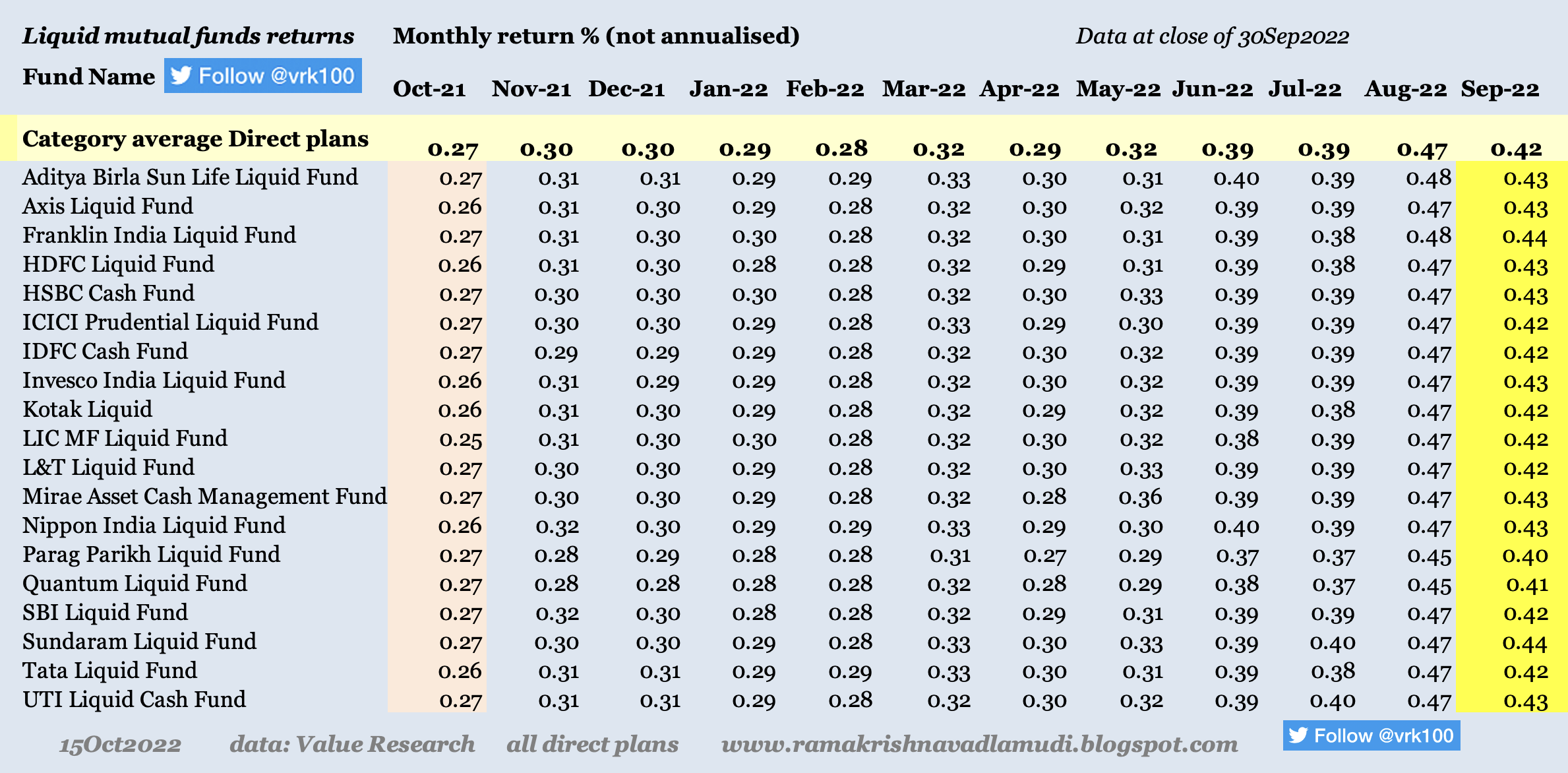
Update 15Oct2022: Liquid mutual fund returns: Data from Oct2021 to Sep2022  >

Value Research data link 

As short term interest rates (like call money rate, Treasury Bill rates, etc.) have shot up in the economy in the past three to six months, there is an improvement in liquid mutual fund returns now. One-year liquid fund return fetched 3.20 percent  back in Dec2021 and now they are quoting at around 4.10 percent (direct plans of liquid funds). 

But the liquid fund returns are much lower than 364-day Treasury Bill rate, which is around 7.00 percent a few days back and current call money rates of 6.15 percent. Even bank fixed deposit interest rates have improved in recent months.


Update 14Jul2022: Liquid mutual fund returns: Data from Jul2021 to Jun2022  > 

There is a sharp spike in liquid MF returns in the month of June 2022 to 0.39 percent from 0.32 percent in May2022, driven by rising interest rates in India >


Update 19May2022: Liquid mutual fund returns: Data from May2021 to Apr2022  >   


Update 01Feb2022: Liquid mutual fund returns: Data from Feb2021 to Jan2022  >  


References:

Note 1: "The Age of Turbulence: Adventures in a New World" By Alan Greenspan

Scribd Sovereign Wealth Funds 25Oct2007

Value Research liquid mutual funds returns

my tweet 05Jun2021 liquid funds


my tweet 04Feb2021 liquid funds


- - -

Disclosure:  I've vested interested in Indian stocks and other investments. It's safe to assume I've interest in the financial products discussed, if any.

Disclaimer: The analysis and opinion provided here are only for information purposes and should not be construed as investment advice. Investors should consult their own financial advisers before making any investments. The author is a CFA Charterholder with a vested interest in financial markets. 

CFA Charter credentials  - CFA Member Profile

CFA Badge


He blogs at:

https://ramakrishnavadlamudi.blogspot.com/

https://www.scribd.com/vrk100

Twitter @vrk100 


Tuesday, 21 September 2021

India Macro Data - vrk100 - 21Sep2021

India Macro Data  


The following are some of the important data points relating to Indian economy. 

1) G-Sec Outstanding: Rupee outstanding loans of Government of India (GOI) as on 20Sep2021 are Rs 77.02 lakh crores (excluding special securities). This figure is also known as G-Sec (Government Securities) outstanding. The data source is Reserve Bank of India. 


--------------------

Read more:

Bond Basics: All You Want to Know About Bonds  

Stocks, Bonds, Rupee and Inflation - How Are They Inter-connected?  

Government Securities Market in India & Duration Management  

Indian Economy's Strengths and Weaknesses  

Rising Government Debt and Fiscal Deficit  

Cash Management Bills and Government Borrowing  

Basics of Inflation-Indexed Bonds 


--------------------


The data from 1999 to 2021: As can be gleaned from table 1 below, the outstanding G-Sec amount has increased by 120 per cent during the Modi Government regime (from Rs 35.14 lakh crore in March 2014 to Rs 71.68 lakh crore in March 2021). During the Manmohan Singh Government (2004 to 2014), the outstanding G-Sec surged by 280 per cent.

The G-Sec amount does not include other public debt and external debt. 

Table 1:


2) Ownership pattern of Govt of India Date Securities: The biggest holders of G-Secs are commercial banks. They hold 37.8 per cent of total outstanding, which is Rs 71.68 lakh crore as on 31Mar2021. The second and third biggest holders are insurance companies (25.3 per cent) and Reserve Bank of India (16.2 per cent). The next in line are provident funds (4.44 per cent), mutual funds (2.94 per cent) and FPIs (foreign portfolio investors 1.87 per cent).

Table 2:


3) Ownership Pattern Over the Years: As per the latest data, as at the end of June 2021, available from Reserve Bank of India (RBI) and Govt of India, the biggest holders of Govt of India Dated Securities are commercial banks (36.0 per cent), insurance companies (25.8 per cent) and Reserve Bank of India (17.1 per cent). The outstanding amount is Rs 78,82,533 crore (end-Jun2021).

In the past five years, the share of commercial banks has decreased to 36 per cent (Jun2021) from 39.9 per cent (Jun2016); the share of insurance firms rose to 25.8 per cent from 22.6 per cent; and the share of RBI rose to 17.1 per cent from 14.9 per cent five years ago.

In the past three years, the RBI has been buying government securities (G-Secs) aggressively which is reflected in its increased ownership pattern. It may be noted this period is coincided with the current RBI governor Shaktikanta Das.

Table 3:


4) Yield and Maturity of Govt of India Dated Securities: Despite persistently high inflation above six per cent for most of the past 20 months, RBI has been able to borrow government securities from the market at or below six per cent yield (see table 4 below). RBI in the past two years, has been resorting to heavy buying of government securities through its Open Market Operations (OMO), which has kept the India 10-year G-Sec yield well below six per cent. 

It may be noted RBI is the money manager for Gov't of India in the sense that RBI borrows money from the market on behalf of Gov't of India.


Table 4:


Weblinks:

RBI public debt statistics

RBI Time Series on public debt

Govt of India public debt management  - quarterly reports

RBI 15Sep2021 Handbook of Statistics on Indian Economy - RBI DBIE (click on 'Handbook of Statistics on Indian Economy' section)page


- - -

Disclosure:  I've vested interested in Indian stocks and other investments. It's safe to assume I've interest in the financial products discussed, if any.

Disclaimer: The analysis and opinion provided here are only for information purposes and should not be construed as investment advice. Investors should consult their own financial advisers before making any investments. The author is a CFA Charterholder with a vested interest in financial markets. 

CFA Charter credentials  - CFA Member Profile

CFA Badge


He blogs at:

https://ramakrishnavadlamudi.blogspot.com/

https://www.scribd.com/vrk100

Twitter @vrk100 


Thursday, 5 August 2021

US Dollar Sales and Purchases by Reserve Bank of India - vrk100 - 05Aug2021

US Dollar Sales and Purchases by Reserve Bank of India 


(Updated charts from Dec2024 onwards are available in India Forex Data Bank blog)  


(note: Updates with latest information chart as of Mar2024, Jan2024, Sep2023, Jul2023, May2023, Jan2023, Sep2022, Aug2022 and May2022 are available at the end of this blog) 


One of the major factors affecting US dollar - Indian  rupee (USD-INR) exchange rate is the market intervention by India's central bank Reserve Bank of India in the foreign exchange (forex) market through sales and purchases of US dollar. The official RBI line is that it intervenes in forex market with a view to curtailing volatility in the exchange rate.

----------------------

Read more: Fed Tapering is Postponed

----------------------

RBI releases the monthly aggregate data of USD sales and purchases with a lag of two months. For example, the data for the month of July 2021 will be released in September 2021 as part of RBI's monthly bulletin.

As of today, the data till May 2021 are available. After selling US dollars to the tune of USD 6.92 billion in February and March this year, RBI again started buying USD in April and May this year. During May 2021, RBI net intervention in the forex market is to the tune of USD 5.84 billion.

The monthly data from January 2019 to May 2021 are given below (please click on the image for a better view):


References:

My tweet thread dated 17Jun2021 


- - -


P.S.: After writing the blog, the following updates are added with new information / images:
 
Update 22May2024:  , RBI net India Forex Reserves data from FY 2008-09 to FY 2023-24 including data of Fx reserves accretion / depletion, net sale / purchase of US dollars by RBI and USD INR exchange rate.


Update 22May2024:   In FY 2023-24, RBI net bought US dollars worth USD 41.3 billion, against net sales of USD 25.5 billion in FY 2022-23. After selling dollars net for four months consecutively between Aug and Nov2023, RBI was buying net dollars in the past four months consecutively.


Update 20Mar2024:   In the first 10 months of FY 2023-24, RBI net bought US dollars worth USD 19.5 billion. After selling dollars net for four months consecutively between Aug and Nov2023, RBI was buying net dollars in Dec2023 and Jan2024.


Update 16Nov2023:   In the first half of FY 2023-24, RBI net bought US dollars worth USD 17.687 billion. Interestingly, for two consecutive months in Aug2023 and Sep2023, RBI was selling US dollars -- obviously to stem the fall of rupee vs dollar.


Update 21Sep2023:   In FY 2022-23, RBI net sold US dollars worth USD 25.52 billion to prop up a depreciating Indian rupee versus the US dollar. However, from Apr to Jul2023, RBI net bought US dollars worth 23.05 billion.


Update 27Jul2023:   In FY 2022-23, RBI net sold US dollars worth USD 25.52 billion to prop up a depreciating Indian rupee versus the US dollar. However, in April and May, RBI net bought US dollars worth 15.08 billion.


Update 21Mar2023:   In FY 2022-23 (10 months data till Jan2023), RBI net sold US dollars worth USD 26.52 billion to prop up a depreciating Indian rupee versus the US dollar.


Update 18Nov2022:   In the past five months (Jun2022 to Sep2022), RBI sold dollars worth USD 37.38 billion, with a view to defending the depreciating Indian rupee versus the rising US dollar > mainly as a result of the rupee defense by RBI in the past one year or so, India's forex reserves are down by more than USD 100 billion to USD 544.72 billion as on 11Nov2022 > 


 Update 17Oct2022:   After one of the highest USD sales in a single month of USD 19 billion in Jul2022, the USD sales by RBI are dramatically down to USD 4.3 billon in Aug2022 >


Update 19Jul2022:   After highest net sale of US dollars by RBI in a single month in Mar2022 in more than a decade, RBI bought USD to the tune of about USD 4 billion in April and May of 2022 > 


 Update 18May2022:   Highest net sale of US dollars by RBI in a single month since Oct2008 (after Lehman Brothers collapse) -- in Mar2022, RBI net sold USD 20.1 billion versus net sales of USD 18.7 billion in Oct2008 -- of course, 2022 economy is bigger compared to 2008 economy -


 Update 23Feb2022:   


Update 17Dec2021:


Update 29Nov2021: 


Update 25Sep2021:


Update 22Aug2021: During the month of June 2021, RBI's net purchases of US dollars are to the tune of USD 18.63 billion, this is the highest figure in the history of RBI. (Of course, Indian economy has grown hugely--to that extent the absolute numbers look higher and higher always).


Disclosure:  I've vested interested in Indian stocks and other investments. It's safe to assume I've interest in the financial products discussed, if any.

Disclaimer: The analysis and opinion provided here are only for information purposes and should not be construed as investment advice. Investors should consult their own financial advisers before making any investments. The author is a CFA Charterholder with a vested interest in financial markets. 

CFA Charter credentials  - CFA Member Profile

CFA Badge