Showing posts with label PSB. Show all posts

Friday, 3 December 2021

Update - Bank Disintermediation and Flow of Resources to Commercial Sector - vrk100 - 03Dec2021

Update - Bank Disintermediation and Flow of Resources to Commercial Sector


This is an update of my article 'Bank Disintermediation and Flow of Resources to Private Sector' dated 26Sep2020:


The corporate sector and households in India raise resources from a variety of sources. Due to bank disintermediation, the commercial sector in India has got a slew of sources to raise monies from. 

The commercial sector has diversified its sources of finance to non-banking finance companies (NBFCs), stock market, rights issues, private placement and foreign sources like external commercial borrowings (ECBs) and foreign direct investment (FDI).

-------------------

Read more:

India Second Quarter GDP 

Global bond yields and Interest rates

Do Paint Stocks and Crude Oil Tango?

BSE Broad and Sectoral Indices Returns

Real Estate Stocks and REITs

When Will Federal Reserve Raise Interest Rates? 

The Central Triad in Taleb's Antifragile

Weblinks and Investing

-------------------


Those interested for a detailed analysis of bank disintermediation and flow of private sector resources may refer to my article written in 2020.  

In this article, I'm providing just an update with data available up to financial year 2020-21.

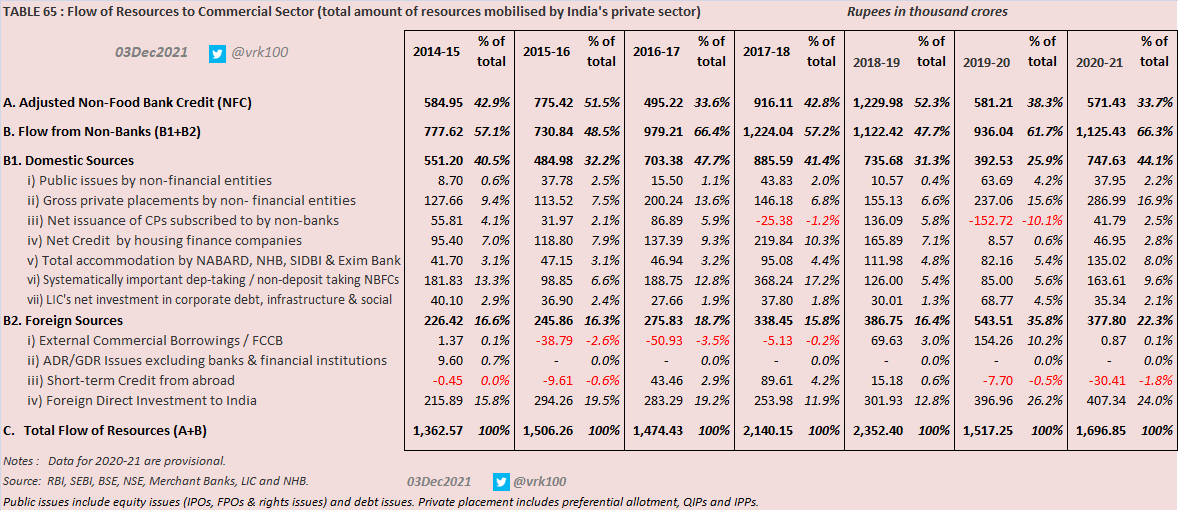
Chart providing data from 2014-15 to 2020-21 (click on the image for larger picture) >


During 2020-21, the money flow to the commercial sector increased by 11.8 per cent to Rs 16.97 lakh crore (Rs 15.17 lakh crore in 2019-20), showing an absolute growth of Rs 1.80 lakh crore -- of which major growth is from commercial paper issued by non-banks (row B1 iii), credit from NBFCs and accommodation by all-India financial institutions, such as, NABARD, NHB, etc.

Interestingly, money raised from ECBs is almost nil in 2020-21, while growth in FDI is just Rs 10,000 crore. The share of foreign sources fell to 22 per cent of the total flow in 2020-21 from 36 per cent in 2019-20.

As can be gleaned from the above table, the private sector's reliance on bank credit has come down from 42.9 per cent in 2014-15 to 33.7 per cent in 2020-21, as per data from Reserve Bank of India (RBI). The share of bank credit in total resources fluctuated between 34 per cent and 52 per cent of total flow in the past six years.

The media often highlight the fact that bank credit growth is tepid, as if it is the only source of funding for the commercial sector. As we've seen, the importance of bank credit for the growth of commercial sector in India has come down drastically over the years and as such you may correct the ignorant media above this.

- - -

References:

RBI Handbook of Statistics on Indian Economy 15Sep2021

Table 65: Flow of Resources to the Commercial Sector in India

My tweet dt 26Sep2020 on Flow of Resources to the Commercial Sector

My tweet dt 15Sep2018 on Flow of Resources to the Commercial Sector

RBI Mint Street memo dated 03Jan2018 Credit Disintermediation from Banks - Has the Corporate Bond Market Come of Age?


Disclosure:  I've vested interested in Indian stocks. It's safe to assume I've interest in the stocks discussed, if any.

Disclaimer: The analysis and opinion provided here are only for information purposes and should not be construed as investment advice. Investors should consult their own financial advisers before making any investments. The author is a CFA Charterholder with a vested interest in financial markets. He blogs at:

http://scribd.com/vrk100

Twitter @vrk100    

Saturday, 26 September 2020

Highest Job Potential by Private Sector Banks-VRK100-26Sep2020

Highest Job Potential by Private Sector Banks-VRK100-26Sep2020

One of the biggest myths in India is public sector companies provide more jobs as compared to the private sector until you look at the hard data. Politicians and other vested interests tend to reinforce this stereotype.


Data always surprise us. When you start looking at the data, the false image begins to evaporate. For example, private sector banks (PVBs) provide more jobs versus public sector banks (PSBs).


In the last five years, PSB staff strength fell by 0.3 per cent between 2013-14 and 2018-19, while that of PVBs surged by 59 per cent and total bank staff rose by 22 per cent, as per latest data available from Reserve Bank of India (RBI).


Between this five-year period, total bank staff strength increased by 22 per cent to 13,05,000. This total is inclusive of public sector, private sector, foreign, cooperative and small finance banks. In the same period, PSB staff strength declined by 0.3 per cent to 6,84,000, and their share in total bank staff fell from 64 per cent in March 2014 to 52.4 per cent in March 2019.


In this period, how did private sector banks fare? Their staff strength has gone up by 59 per cent to 4,67,000, and their share in total bank staff increased from 27.4 per cent to 35.7 per cent.  


The growth rates for other banks (foreign, cooperative and small finance banks) can be seen in the below table.


However, it is fair to argue that public sector banks have a lot of legacy issues to deal with. To come out of this, PSBs have been trying to reduce their staff strength through the process of natural superannuation and voluntary retirement.


It is worthwhile to mention that private sector banks have been taking more of the market share and it is mostly coming at the expense of public sector banks, who are saddled with high percentage of bad loans. As a result, PSBs are unable to grow their business and have been losing out to PVBs.


It may be noted that the bank staff numbers provided in the below table include those of officers and clerks; but exclude subordinate staff--as it is not fair to compare the subordinate staff (a legacy for PSBs) from a productivity viewpoint.


As per RBI press release dated 14 March 2019, IDBI Bank ceased to be a public sector bank and it became a private sector bank after LIC of India acquired a majority stake in the bank.


Table: Bank-wise distribution of staff (please click on it for larger image) >


 - - -


References:

RBI Handbook of Statistics on Indian Economy 18Sep2020

Bank-wise Distribution of Staff

Disclosure:  I've vested interested in Indian stocks. It's safe to assume I've interest in the stocks discussed, if any.

Disclaimer: The analysis and opinion provided here are only for information purposes and should not be construed as investment advice. Investors should consult their own financial advisers before making any investments. The author is a CFA Charterholder with a vested interest in financial markets. He blogs at:

http://scribd.com/vrk100


Twitter @vrk100     


Bank Disintermediation and Flow of Resources to Private Sector-VRK100-26Sep2020

Bank Disintermediation and Flow of Resources to Private Sector-VRK100-26Sep2020


(Update dated 03Dec2021 of this article is available)

Private sector in India raises resources from a variety of sources. Private sector includes both the corporate sector and households. The corporate sector raises monies traditionally from banks. Over the years, they have diversified their sources. Now, they tend to raise resources from domestic sources, such as, non-banking finance companies (NBFCs) and stock market. Routes for raising money from stock market include: initial public offers - IPOs; follow-on public offers - FPOs; rights issues or through private placement (like, qualified institutional placement or QIP). 


A related topic in corporate finance is pecking order theory, which shows the order in which corporates prefer to raise resources. As per pecking order theory, it is cheaper and easier for corporates to obtain resources internally. So, the first order of preference is raising internal resources. And the second in line is debt, because cost of debt is cheaper, due mainly to tax efficiency, versus cost of equity. And the last in line is equity after exhausting the first two options.


The private sector raises resources from external sources also, via foreign currency loans in the form of foreign currency convertible bonds (FCCBs) and external commercial borrowings (ECBs). More importantly, Indian corporates attract a lot of money from foreign direct investment (FDI) route.


Financial market professionals (FMPs) often focus on bank credit growth rate, which is a high frequency indicator. With rapid changes in bank disintermediation, credit to the private sector is now dominated by non-bank sources. As a result, bank credit growth numbers have become less relevant in India like their Western counterparts. When we say bank credit growth rate has fallen to 5% or 6%, it conveys little meaning.


Bank disintermediation means raising of resources by the private sector (both the corporate as well as households) from entities other than banks. This disintermediation, started in the early 1990s, has been going on with the share of non-banking sources growing rapidly in recent years.


Chart providing data from 2009-10 to 2019-20 (click on the image for larger picture) > 


As can be seen from the above table, the private sector's reliance on bank credit has come down from 42.9% in 2014-15 to 40.2% in 2019-20, as per data from Reserve Bank of India (RBI). The share of bank credit fluctuated between 34% and 52% of total flow in the past five years.


Large sums of money have flowed into debt mutual funds in recent years. As a result, mutual funds' role in providing resources through bond investments in the corporate sector has gone up considerably as can be observed from steep rise in assets managed by the mutual funds, which typically invest in bonds of companies, NBFCs and HFCs.


Changes in FY 2019-20 compared to FY 2018-19:

As can be seen from the above table, resources mobilisation by the private sector declined drastically in 2019-20.


Total flow of resources to commercial sector fell by 39% in 2019-20 to Rs 14.46 lakh crore from Rs 23.52 lakh crore in 2018-19--this decline has adversely impacted India's GDP growth. The fall is mainly due to steep fall in bank credit by 53% to Rs 5.81 lakh crore and fall in commercial paper (CP) issuance. Others that contributed to the decline are credit by HFCs (95% fall to just Rs 8,600 crore loan disbursement) and NBFCs (89% fall to just Rs 13,600 crore).


Post IL&FS scam, loan disbursals by housing finance (HFCs) and non-financial banking companies (NBFCs) got decimated. Commercial banks too are having their own problems especially public sector banks (PSBs). Stung by high percentage of bad loans, PSBs are extremely averse to lending. Another issue that deters PSBs from lending is the onerous scrutiny of bad loans by central government enforcement agencies, such as, Central Vigilance Commission and others.


One bright spot for corporates in 2019-20 is foreign direct investments (FDI) into India, which surged by 32% to Rs 3.97 lakh crore. LIC of India's debt investments increased by nearly 130% to Rs 69,000 crore, which is the highest in the last 10 years.


Public issues and private placements too have shown significant rise. External flows from ECBs and FCCBs went up by more than 120% to Rs 1.54 lakh crore in 2019-20.


Lower finance from banks and NBFCs has negatively impacted the automobile sector--which depends heavily on finance.


In the past five years, flows from domestic sources have fallen by more than 40% to Rs 3.21 lakh crore in 2019-20, while flows from external sources have increased by 140% to Rs 5.44 lakh crore, signifying India's dependence on foreign money.


- - -

P.S.: Updated data which include data for 2020-21 > 


References:

My tweet dt 26Sep2020 on Flow of Resources to the Commercial Sector

My tweet dt 15Sep2018 on Flow of Resources to the Commercial Sector

RBI Mint Street memo dated 03Jan2018 Credit Disintermediation from Banks - Has the Corporate Bond Market Come of Age?

RBI Handbook of Statistics on Indian Economy 18Sep2020

Table 68: Flow of Resources to the Commercial Sector in India


Disclosure:  I've vested interested in Indian stocks. It's safe to assume I've interest in the stocks discussed, if any.

Disclaimer: The analysis and opinion provided here are only for information purposes and should not be construed as investment advice. Investors should consult their own financial advisers before making any investments. The author is a CFA Charterholder with a vested interest in financial markets. He blogs at:

http://scribd.com/vrk100


Twitter @vrk100